
80-90% of the job listings you see are not actually a fit
Traditional Job Hunting: It always starts the same way
You open a traditional job board. LinkedIn, Indeed, Monster - it does not matter. A blank field stares back at you: "Job title or keyword".
You type something. "Project Manager." "Data Analyst." "Marketing Lead." Then press Enter.
And suddenly, hundreds of job listings appear.
That is keyword-based job searching. It has been the default method for years. It is also one of the least effective ways to find a relevant job in 2026, particularly if you are considering a career pivot.
The Search Engine Flaw: You don't know the exact keywords
This is not a candidate problem. It is an algorithmic failure.
The job market has no shared naming standard. The same role can be posted under drastically different titles depending on company culture, industry jargon, or HR habits ("Growth Hacker" vs. "Digital Marketing Manager").
So what happens: - You miss perfectly aligned job opportunities because the employer used a title you didn't guess. - You are overwhelmed by superficial matches that contain the right keyword but demand entirely wrong skill sets.
Keyword search only checks a dictionary.
The Employer Side: Job descriptions are notoriously noisy
A job listing is not clean data. It is a human-written text: sometimes vague, outdated, or overloaded.
In real life, you often see: - unclear descriptions, - requirement lists inconsistent with seniority, - titles that do not reflect the actual role.
Result: you manually filter noise, listing by listing.
The outcome: a massive attention drain
Across internal CVScope tests on multiple profiles, the pattern is consistent: roughly 80-90% of listings returned by classic keyword search do not meet useful fit quality.
In CVScope, a listing is considered non-relevant when its fit score is below 70.
So this is not about motivation. It is about method.
What CVScope does differently
Traditional search starts with words. CVScope starts with your trajectory.
1) Deep CV analysis
CVScope extracts the real structure of your profile: - technical skills, - transferable skills, - career trajectory, - capacity signals, - preferred domains, - plausible target roles and roles to avoid.
Goal: model your real market credibility, not just your latest title.
2) Credible target roles with confidence score
Instead of making you guess keywords, CVScope proposes realistic target role families with a confidence score.
That score indicates how credible each role is based on your background.
3) Listing scoring based on real alignment
CVScope evaluates each listing by content, not title alone: - domain match, - target seniority alignment, - transferable skill compatibility, - overall trajectory and career goal coherence.
The displayed score is a multi-dimensional alignment score. Anything above the 70 threshold isolates your best career opportunities.
Visual Examples: Resume Job Matching in Action
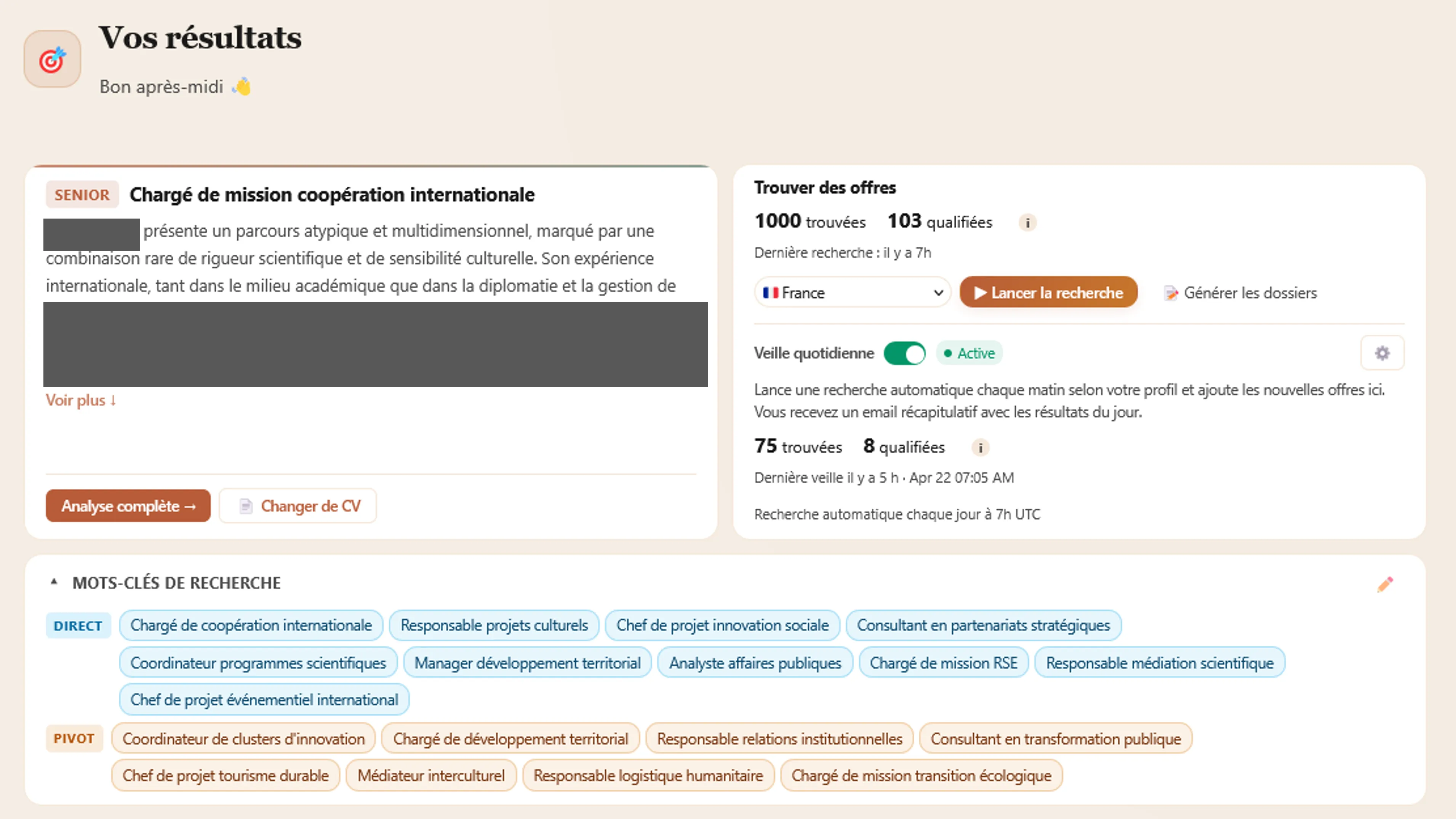
Example 1 - Illustration of semantic noise and wasted time generated by keyword filtering.
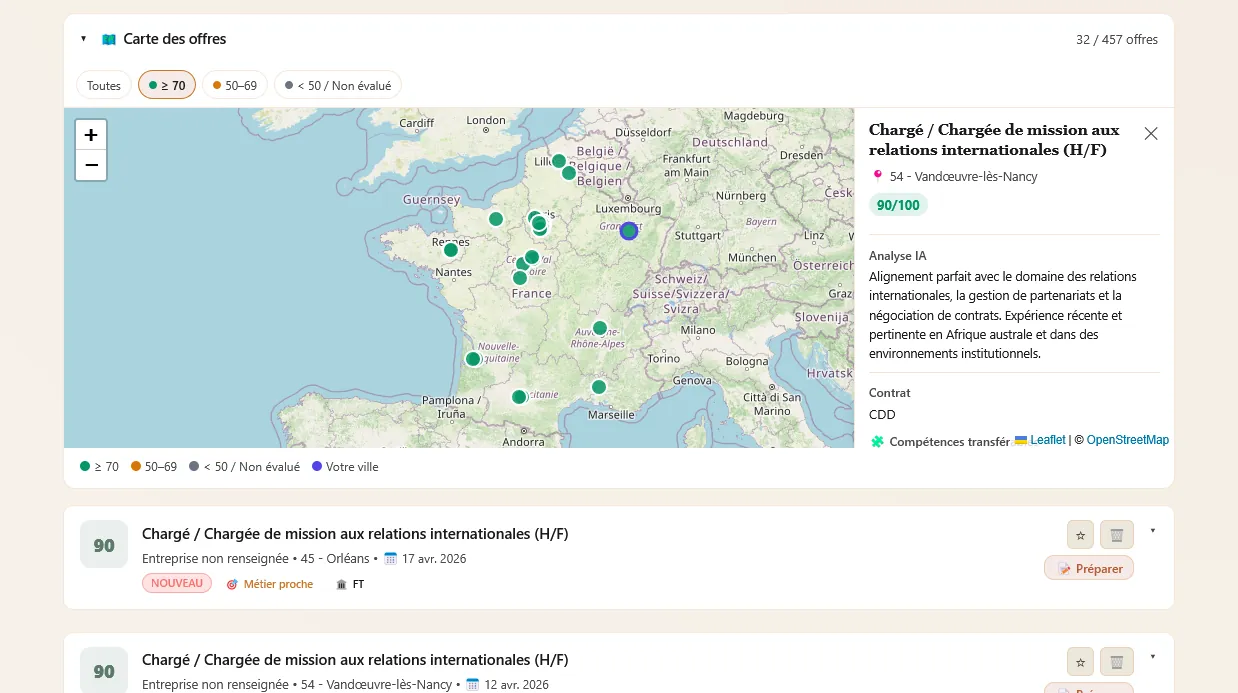
Example 2 - CVScope dashboard highlighting the AI skill alignment algorithm: job matching working for the applicant.
Conclusion: AI Job Matching vs. Manual Keyword Search
| Traditional Job Boards | CVScope AI Matching |
|---|---|
| You pick a keyword (usually missing variations) | CVScope deduces real targets from your entire CV |
| Endless irrelevant job listings | Objective prioritization via alignment scoring |
| Manual, exhausting filtering listing by listing | Intelligent pre-filtering of employer requirements |
| One generic cover letter for everything | AI-tailored application documents for each role |
Ready to upgrade your job search?
Stop fighting the algorithms on standard job boards. Let artificial intelligence analyze your true capabilities (not just your keywords) to source roles genuinely designed for you.
-> Upload your CV for free to uncover matched job opportunities
No account required to get started.